This article may seem complex for those unfamiliar with system development. Although it involves important tasks for creating a system, feel free to move on to the next article if you get tired.
Digital Representation of the Score
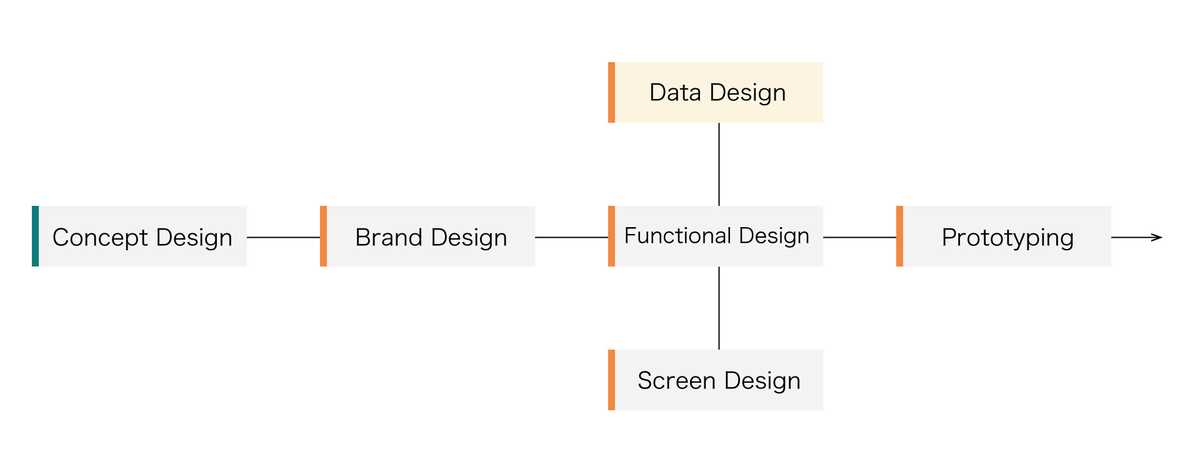
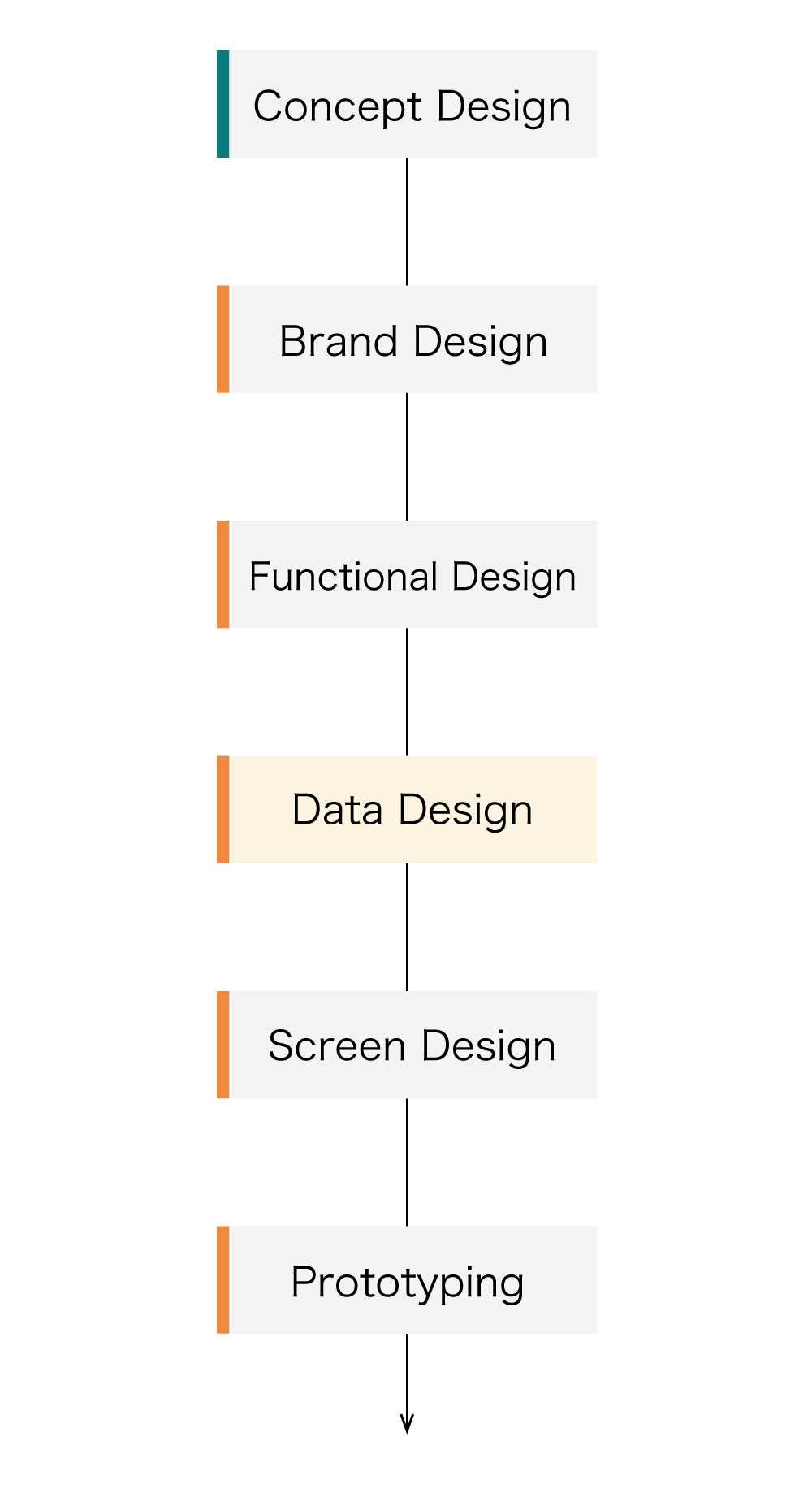
To handle a specific concept within a system, it’s necessary to define that concept precisely. Systems are inflexible, so it’s essential to clarify what the concept entails beforehand. For instance, if a library management system is being developed to handle the concept of “books,” rules need to be established, such as a book having a title, an author, and publisher information.
While a title for a book may seem obvious, unexpected situations can arise as development progresses. For example, how would data be stored in the case of co-authors? This is why deciding on a data structure on the fly can lead to regrets later in system development. Since the concept of "boxing notation" is new, we want to define it carefully.
In thinking about Sheet Boxing, we have often referred to musical analogies, and this approach may be useful in system design as well. Music has already been incorporated into the digital world and is managed as data within systems. There are several standards for defining music digitally, but we’ll reference the MusicXML standard.
XML is a set of rules for communication with systems. While humans don’t need strict rules as long as they speak the same language, systems require predefined rules to understand commands. There are many types of XML, and HTML—interpreted by the internet browsers we use daily—is one kind. Similarly, there’s a MusicXML standard for music, so we’ll consider naming the standard for Sheet Boxing as “BoxingXML.”
Overview of MusicXML
Organized by Part or Measure?
This is the root document type. The <score-partwise> element is made up of parts, where each part is made up of measures. There is also a <score-timewise> option which is made up of measures, where each measure is made up of parts.
When considering music with multiple parts like an orchestra, there are two options: describing each part from start to finish by measure, then moving to the next part, or writing each measure by including all parts for that measure. MusicXML allows both approaches, providing flexibility that may seem indecisive to system developers.
Given that symphonies may involve performers leaving the stage mid-performance, allowing parts to change mid-piece becomes necessary. Thus, a timewise approach seems essential. However, as it’s unlikely that each part varies in length, it seems preferable to keep specifications simple by focusing solely on timewise. MusicXML developers likely allowed both after considering various use cases, so we’ll respect this choice without diving too deeply.
<part-list>
    <score-part id="P1">
        <part-name>Part 1</part-name>
    </score-part>
</part-list>
In music, this would be where you set parts like first violin, second violin, viola, and cello. In the case of BoxingXML, since we are currently only considering shadowboxing or sparring, distinctions such as red corner and blue corner are likely to be set here. Additionally, in boxing, movements are reversed depending on whether the stance is orthodox or southpaw, so we’ll create a part-stance tag to handle this.
A Measure in Boxing is a "Contact"
We are starting the first measure in the first part.
In boxing, there’s no concept of a measure as in music, so instead, we introduced the concept of a Contact.
(When observing a boxing match,) after both sides attack each other, they often separate to a safe distance, gather themselves, then resume fighting. We’ll call this cycle of closing in and separating a “Contact.”
Thus, we’ll interpret the measure tag as a contact tag moving forward.
Does a Punch Have Length?
Each note in MusicXML has a <duration> element. The <divisions> element provides the unit of measure for the duration element in terms of divisions per quarter note.
In MusicXML, note duration is defined by the duration tag for each note and the divisions tag for each measure. While music notes can have sustain, punches in boxing do not, so there’s no concept of length here. However, we still want to distinguish between rhythms like “Tan, Tan, Tan” and “Tan, Tatan,” similar to quarter and eighth notes, so we need the duration tag for this differentiation.
Since Contact length varies based on the outcome of each clash, divisions cannot be used here. Instead, in BoxingXML, Contact length will be expressed as an absolute number. First, BoxingXML will define a quarter-note punch as having a length of 1, so if a Contact contains three punches represented by quarter notes, its length will be 3.
What Are the Basic Elements of Boxing Movements?
In MusicXML, each note contains information on pitch and duration.
<note>
    <pitch>
        <step>C</step>
        <octave>4</octave>
    </pitch>
    <duration>4</duration>
    <type>whole</type>
</note>
At this point, BoxingXML needs to diverge from MusicXML. While sheet music consists of notes and rests, boxing movements may include not only punches (represented by notes) but also defense and stepping actions alone.
In the previous article, we stated that boxing actions consist of three independent elements: offense, defense, and stepping, which is a core design principle of this service.
Design Principle: Boxing actions consist of three independent elements: offense, defense, and stepping.
Keeping this in mind as we design the data structure, the contents of the move tag, which represents a boxing action, should look like this:
<move>
    <offense />
    <defense />
    <step />
</move>
Details of Offense
We previously outlined the rules for structuring Sheet Boxing when we considered its application to kicks, so let’s review the relevant rules.
- The position on the staff differentiates punch trajectories.
- The shape of the notehead represents the target area.
- The direction of the stem distinguishes punches from kicks.
In MusicXML, the pitch tag represents pitch, the notehead tag represents the notehead shape, and the stem tag represents the stem direction. We’ll retain these for BoxingXML.
Additionally, feints are represented by adding a slash to the notehead, so it’s natural to represent them with the notehead tag.
In the world of kicks, even within the same trajectory, there are diverse styles, which we distinguished by adding dots or circles at the stem’s end. Since the pitch tag alone can’t express this nuance, we’ll introduce a tag called quirk to represent variations. Joint-based attacks, like knee or elbow strikes, were indicated by a slash in the middle of the stem, which we’ll also treat as a type of quirk.
Finally, in the interpretation of the one-two, we introduced the hat symbol to distinguish setup punches from intended strikes, so we’ll add a hat tag to represent this.
Thus, the contents of the offense tag will look like this:
<offense>
    <pitch />
    <notehead />
    <stem />
    <quirk />
    <hat />
</offense>
| Item Name | Required | Details |
|---|---|---|
| pitch | ○ | octave: a number from 0 to 9; step: one of C, D, E, F, G, A, or B. |
| notehead | ✗ | rounded, squared, or triangle. Default is rounded. |
| stem | ✗ | up or down. Default is up. |
| quirk | ✗ | dot, rounded, diagonal-line, etc. Details are under consideration. |
| hat | ✗ | If present, displays the hat symbol. |
Details of Defense
Defense movements were primarily defined in Notation for Defenses and Steps, with some additional definitions in Notations for Other Moves.
Here, too, the concept of left and right poses a problem, as discussed in the previous article. The meaning of left and right reverses depending on whether the stance is orthodox or southpaw, so we can’t directly use "left" and "right." Instead, we’ll abstract these as "lead" and "rear," where "left" for an orthodox stance is "lead" and "right" is "rear."
Design Principle: All directional concepts are abstracted as lead and rear.
To represent whether a movement is "lead" or "rear," we’ll introduce an origin tag in the defense tag, indicating the starting side of the action.
<defense>
    <type />
    <origin />
</defense>
| Item Name | Required | Details |
|---|---|---|
| type | ○ | One of block, parry, headslip, weave, duck, or sway. |
| origin | ○ | Required for all types except sway. One of lead or rear. For block, both is also possible. |
Details of Stepping
For stepping, the concept of left and right also needs to be abstracted. In the data structure, a left step in an orthodox stance is understood as a side step with a type of side and an origin of lead.
<step>
    <type />
    <origin />
</step>
| Item Name | Required | Details |
|---|---|---|
| type | ○ | One of front, back, side, or pivot. |
| origin | ○ | Required for side and pivot. One of lead or rear. |
Basic Unit of Boxing Movements
In Functional Harmony in Boxing, we emphasized the importance of distance markers. Even with the same punch and movement, its meaning changes entirely based on the distance from the opponent. Therefore, BoxingXML must also be able to represent distance markers. Since each movement has only one distance, we’ll add a distance tag as a property of the move tag.
Based on this, the complete structure of the move tag, the basic unit of boxing movements, is as follows:
<move>
    <distance />
    <duration />
    <offense>
        <pitch />
        <notehead />
        <stem />
        <quirk />
        <hat />
    </offense>
    <defense>
        <type />
        <origin />
    </defense>
    <step>
        <type />
        <origin />
    </step>
</move>
The Birth of BoxingXML
With the considerations up to this point, we should theoretically be able to represent all aspects of Sheet Boxing as outlined in the conceptual design. Let’s try representing the following image in BoxingXML.
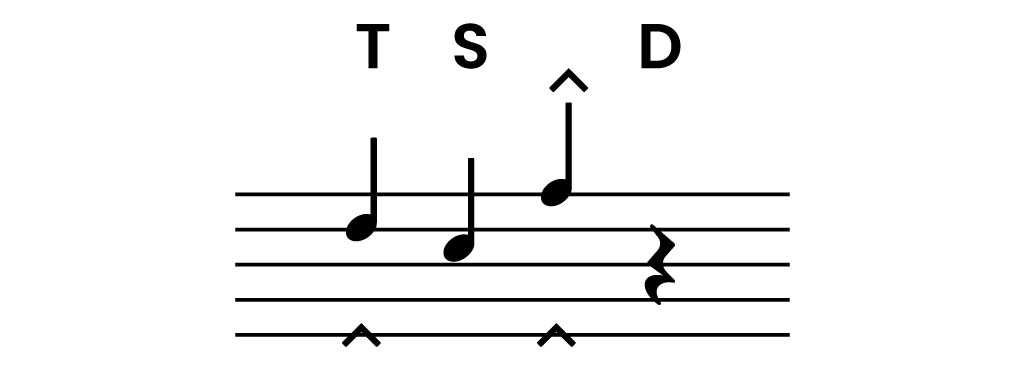 -- From Interpretation of the One-Two
<score-partwise version="4.0">
    <part-list>
        <score-part id="P1">
            <part-name>Red Corner</part-name>
            <part-stance>orthodox</part-stance>
        </score-part>
    </part-list>
    <part id="P1">
    <contact number="1">
        <attributes>
            <durations>4</durations>
        </attributes>
        <move>
            <distance>T</distance>
            <duration>1</duration>
            <offense>
                <pitch>
                    <step>D</step>
                    <octave>4</octave>
                </pitch>
                <notehead>rounded</notehead>
                <stem>up</stem>
            </offense>
            <step>
                <type>front</type>
            </step>
        </move>
        <move>
            <distance>S</distance>
            <duration>1</duration>
            <offense>
                <pitch>
                    <step>C</step>
                    <octave>4</octave>
                </pitch>
                <notehead>rounded</notehead>
                <stem>up</stem>
                <hat />
            </offense>
        </move>
        <move>
            <distance>S</distance>
            <duration>1</duration>
            <offense>
                <pitch>
                    <step>F</step>
                    <octave>4</octave>
                </pitch>
                <notehead>rounded</notehead>
                <stem>up</stem>
                <hat />
            </offense>
            <step>
                <type>front</type>
            </step>
        </move>
        <move>
            <distance>D</distance>
            <duration>1</duration>
        </move>
    </contact>
  </part>
</score-partwise>