Application to Kicking
The concept of sheet boxing isn't exclusive to boxing; it can be adapted to any striking-based martial art. Therefore, let's explore the potential of applying sheet boxing to martial arts that incorporate kicking techniques as well.
Rules of sheet boxing
As we consider expanding the scope of sheet boxing, it's important to examine the rules that were employed in the arrangement of its notations.
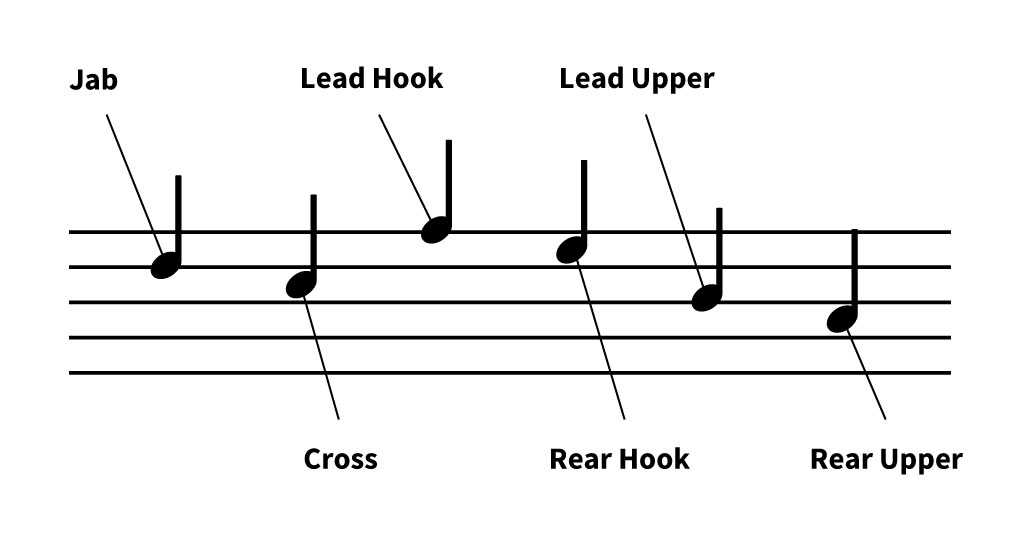
Rule1
A note placed on the line signifies a lead punch (orthodox left-handed blow), while a note positioned between the lines indicates a rear punch (orthodox right-handed blow).
Rule2
The position of a note on the staff corresponds to the trajectory of the punch, differentiating between a straight, a hook, and an uppercut.
Rule3
The shape of the note head in the notation system denotes the target area of the blow.
The notation in sheet boxing is constructed using the aforementioned rules. Moving forward, we will introduce new rules to incorporate kicking techniques into this system.
Rule4
A stem pointing upwards indicates a hand strike, while a stem pointing downwards signifies a foot strike.
Building on rule 2, we aim to position the notes for kicks in the lower half of the staff. For punches, the arrangement from top to bottom was: hook, straight, uppercut. Adapting this for kicks, we abstract these into a hook trajectory (hitting from the side), a straight trajectory (hitting from the front), and an upper trajectory (hitting from below), utilizing these classifications for organizing kick notes.
Furthermore, regarding rule 3, in the context of kicking, it's important to represent not just high and middle kicks, but also low kicks in the notation. Therefore, we will introduce a new symbol to denote an attack targeting the lower region.
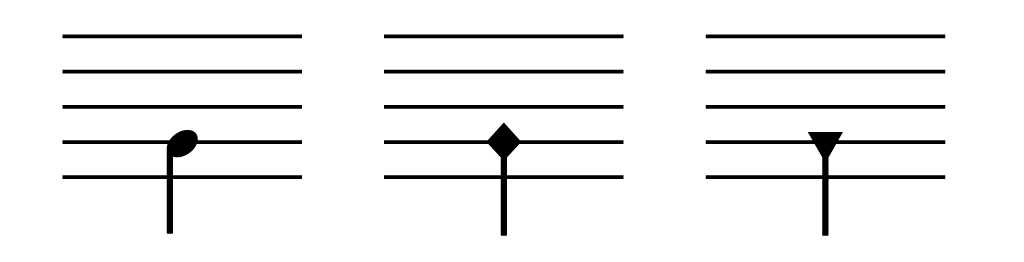 High kick, middle kick, low kick from the left
Boxing score in Karate
Below, we will explore potential sheet boxing notations for Karate. Firstly, let's classify the kicks based on their trajectory. The trajectories are defined as follows.
hook trajectory - hitting from the side
straight trajectory - hitting from the front
upper trajectory - hitting from below
Kicks on hook trajectory
The following kicks fall under the hook trajectory:
- Outer roundhouse kick
- Inner roundhouse kick
- Hook kick
- Back spinning kick
Outer roundhouse kick
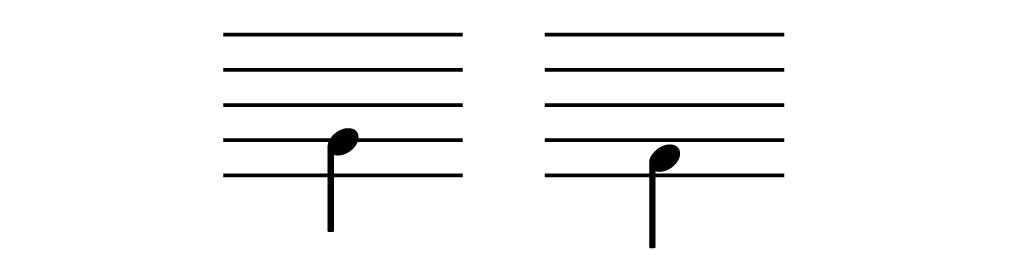
Since the outer roundhouse kick is considered to be a typical kick, it is depicted with a note that does not require any additional symbols.
Inner roundhouse kick
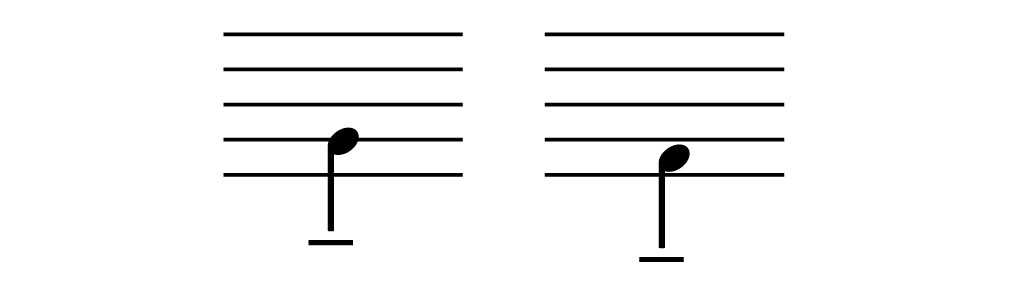
Following that, the inner roundhouse kick strikes the opponent from a trajectory opposite to that of the outer roundhouse kick. Drawing from mathematical notation, where a bar denotes a complementary set, we use a bar placed above the note to signify 'opposite,' thus representing the inner roundhouse kick.
Hook kick

The hook kick is only available with the leg closer to the opponent, and is similar to the side kick and the side kickup described below. Due to the similarities with these, I decided to express it by adding a dot on top of the note.
Back spinning kick

Finally, since the back spinning kick is only performed with the foot farther from the opponent, it is represented by adding a circle above the note to contrast it with the hook kick.
Kicks on straight trajectory
There are two types of kicks that fall under the straight trajectory:
- front kick
- side kick
Front kick
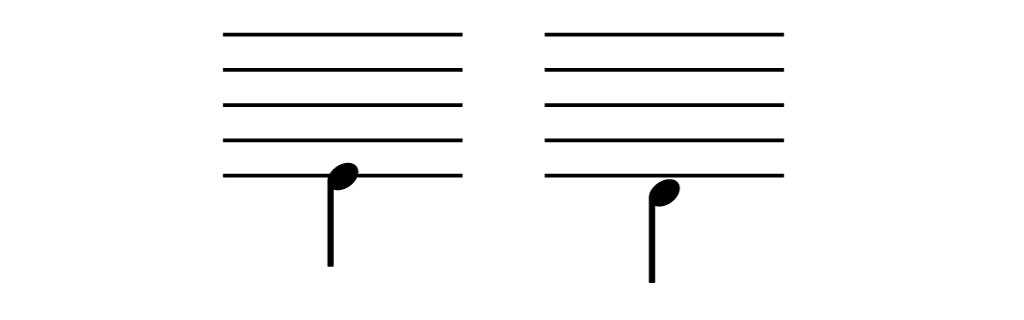
The front kick is the most basic movement among kicks that aim for a straight trajectory, so it is expressed using a note without additional symbols.
Side kick

Given that the side kick is delivered solely with the foot closer to the opponent, its notation is achieved by adding a dot to the note. This maintains a visual similarity with the hook kick and the side kick up, reflecting their related execution styles.
Kicks on upper trajectory
There are two kicks that fall under the upper trajectory:
- kick-up
- side kick-up
Kick-up

Since the kick-up is performed only with the foot farther from the opponent, it is expressed by adding a circle above the note to show the similarities with the back spinning kick.
Side kick-up

Considering the characteristic of the side kick-up, which is performed only with the foot closer to the opponent, we will express it by adding a dot on the note to maintain the similarity between the hook kick and the side kick.
Other kick notations
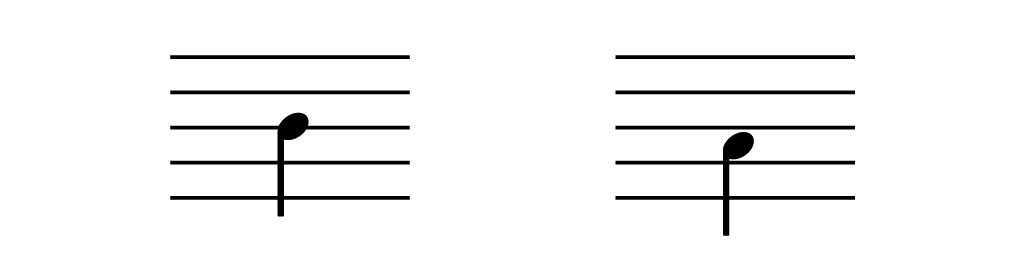
Since heel drops attack the opponent from above, it is not included in any of the trajectories defined above. Intuitively, it seems natural to place it above the hook trajectory. This will conflict with the upper hand, but it can be distinguished by the direction of the stem, so the heel drop can be expressed as follows.
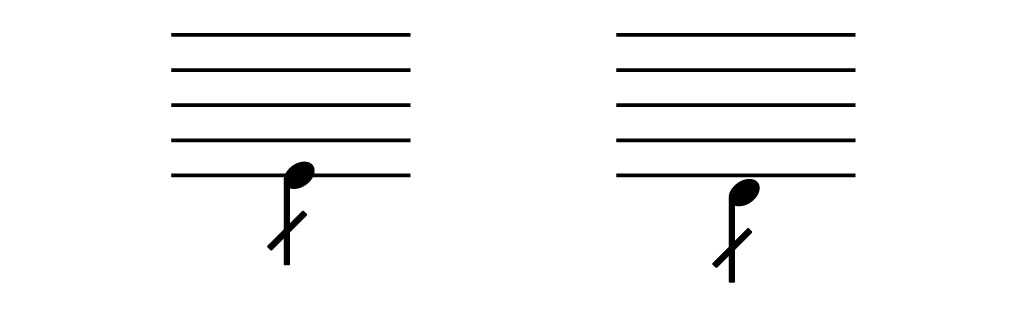
Knee kicks can be considered a straight trajectory. The feature of using a joint in the middle of the leg has nothing in common with any of the previous kicks, so let's devise a new expression. I'll put a diagonal line on the stem to express the idea of using a joint in the middle.
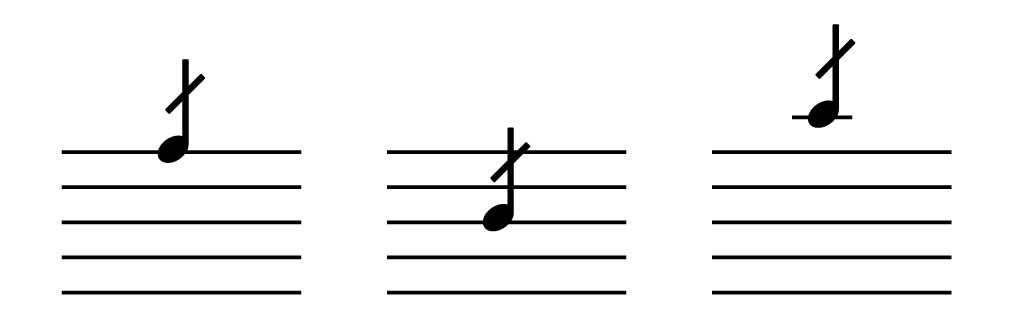
Although prohibited in karate, elbow strikes can be equated to knee kicks in their execution. In Muay Thai, elbow strikes are designed to be delivered from various angles, including from the side, below, and notably from above. Therefore, for elbow strikes aimed downwards, the notation should be placed above the hooks, akin to the heel drop.
Examples of combinations that include kicks
Presented below is a sheet boxing showing the combination of one-two to left middle kick. This demonstrates the capability of sheet boxing to now effectively represent sequences that include both punches and kicks.

Distance for kicks
Distance has different implications in boxing compared to martial arts that incorporate kicking. For instance, while tonic distance in boxing is defined as 'the distance a straight punch can reach by stepping in,' this also coincides with the range attainable by a kick. Hence, it appears essential to reevaluate the concept of distance specifically for martial arts involving kicking.
Nonetheless, while subdividing distances into four or more categories might enhance accuracy, such precision is futile if it's not practically applicable in daily training. Therefore, for simplicity and practicality, it's advisable to restrict the classification of distances to just three categories.