Mapping of Strategies
In the heat of sparring and matches, fighters often experience a diminished capacity to think clearly, making it challenging to remain composed and recall planned strategies. To minimize the cognitive load during a bout as much as possible, it's beneficial to explore methods of mapping out your strategy in a way that creates a vivid mental image, aiding in quick recall and execution.
Mapping based on psychological momentum
Fighters often watch their opponent's face closely during a match. This leads to a kind of silent communication through facial expressions, something that's hard to spot in videos of matches or even in your own sparring footage. But anyone who's sparred knows this communication is real, with each fighter trying to show they're more aggressive and confident.
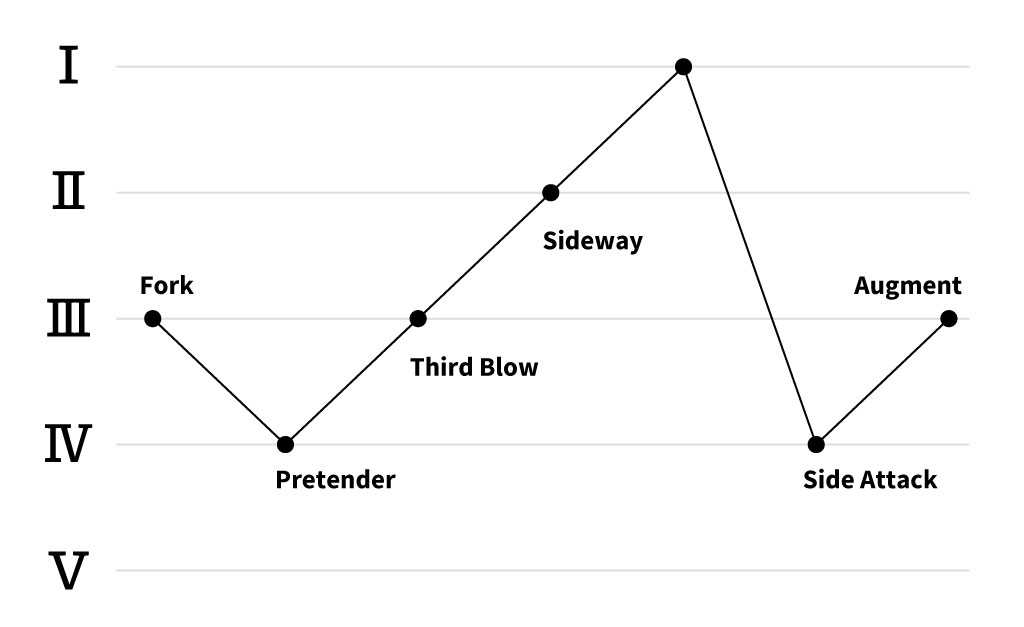
Based on this idea, I want to sort strategies by this feeling of being more dominant or less so. Here's how I'll break it down: Type I is when you're totally in control, really outdoing your opponent in aggressiveness. Type II is when you're a bit ahead. On the flip side, Type V is when your opponent's aggressiveness overpowers you, and Type IV is when you're just starting to lose the edge. When both fighters are equally strong, that's Type III. So we have a range from Type I (most dominant) to Type V (least dominant).
Now, let's take the strategies we talked about earlier and figure out which type of fighting situation they fit best.
Please scroll horizontally through the table below.
| Fight Situation | Psychological State | Strategies |
|---|---|---|
| Type I | Overwhelming the opponent; opponent feels weakened | Rushing Combinations |
| Type II | Confident in reacting to opponent's jab; unafraid of opponent's attack | Sideway |
| Type III | Struggling to break opponent's guard; uncertain about attack strategy | Augment, Fork, Third Blow |
| Type IV | Pressured by opponent; wary of opponent's counter | Pretender, Side-attack |
| Type V | Feeling completely overwhelmed | Clinch |
In combat situations of Type I and Type V, the course of action is straightforward, eliminating the need for complex strategy. In Type I, the focus is on whether you can initiate and complete a rush, a matter of tactics more than strategy. Essentially, the question is whether you can execute a rush attack powerful enough to achieve a knockout. In contrast, Type V represents a scenario where you're on the verge of being knocked down, emphasizing the need for tactics to evade the opponent's onslaught and regain stability.
The distinction between Type II and Type IV situations is particularly noteworthy. In a Type II scenario, your dominance likely leads the opponent to adopt a more passive defense. However, in Type IV, where the opponent's aggressiveness surpasses yours, anticipate their offensive approach and prepare to counter their movements. Each strategy is aligned with these varying combat scenarios.
At a fight's outset, both fighters are typically in a balanced psychological state, suggesting the adoption of a Type III strategy. As the match progresses, if you manage to land a solid hit and sense your opponent's weakness, shift to a Type II strategy. Conversely, if you're hit and start feeling pressured, transition to a Type IV strategy. Adapting your strategy to the evolving dynamics of the fight allows for tactical decisions tailored to the situation.
Relaying strategies
The trainer's advice, "Don't throw meaningless punches," can be interpreted within this series' boxing theory as follows: every movement should be a component of a tactical kadenz, and each kadenz should in turn be part of a larger strategy designed to outmaneuver the opponent.
When considering a match from a strategic viewpoint, an ideal boxer is always in motion, each action grounded in a deliberate strategy. Upon completing one strategic maneuver, they should swiftly transition to the next. It's more efficient to build upon the predictions already established in the opponent's mind for the next strategic move, rather than considering each strategy in isolation. Essentially, the ideal boxer should fluidly connect one strategy to the next, creating a seamless and continuous tactical flow.