Separate Moves and Tactics
How to practice boxing for 8 hours a day
Even if you become obsessed with boxing and want to get stronger, you can only practice at the gym for a few hours at most. The gym I go to has limited hours for use for operational reasons, but essentially, as physical fatigue builds up, it renders you unable to move, leading to less effective exercise.
However, if you are someone who is serious about becoming a professional boxer, or if you are passionate about it and want to put in more effort, you may feel like you are not trying hard enough.
In addition, intense training often leads to injuries. The frustration mounts when you desire to practice but find yourself unable to move your body for extended periods.
With written language, you can study with notebooks
Beginners typically focus on mastering proper punching form during their training sessions. When you shadow box in front of a mirror, your coach will give you individual feedback on your form. These elements encompass the fundamental movement techniques integral to boxing.
On the other hand, during mitt training, you'll be tasked with executing diverse combinations during training. A combination in boxing constitutes a sequence of movements aimed at strategically landing a punch, capitalizing on moments when the opponent is unable to respond effectively. It's a tactical maneuver.
Thus, boxing has a movement aspect and a tactical aspect. However, the two are often taught without a clear distinction between them. Also, when you practice only movements, this applies to situations such as repeating one-twos in front of a mirror. However, focusing solely on tactics appears to be uncommon in boxing. This drawback arises from the absence of a written language. So let's consider a situation where you practice boxing by focusing only on the tactical aspect.
When it comes to mathematics, it can be studied at our desk. This is because there are symbols and equations in the written language. In traditional boxing, there was no written language, so the only way to deal with it was to move directly with your body. However, now that we have sheet boxing, we should be able to practice boxing at our desks.
Preparation before practice
You may have seen musicians on a train preparing for their upcoming performance while looking at sheet music. If we have sheet boxing, we should be able to do the same. For example, you can write down the combinations you want to learn in a notebook and read them to yourself before practicing.
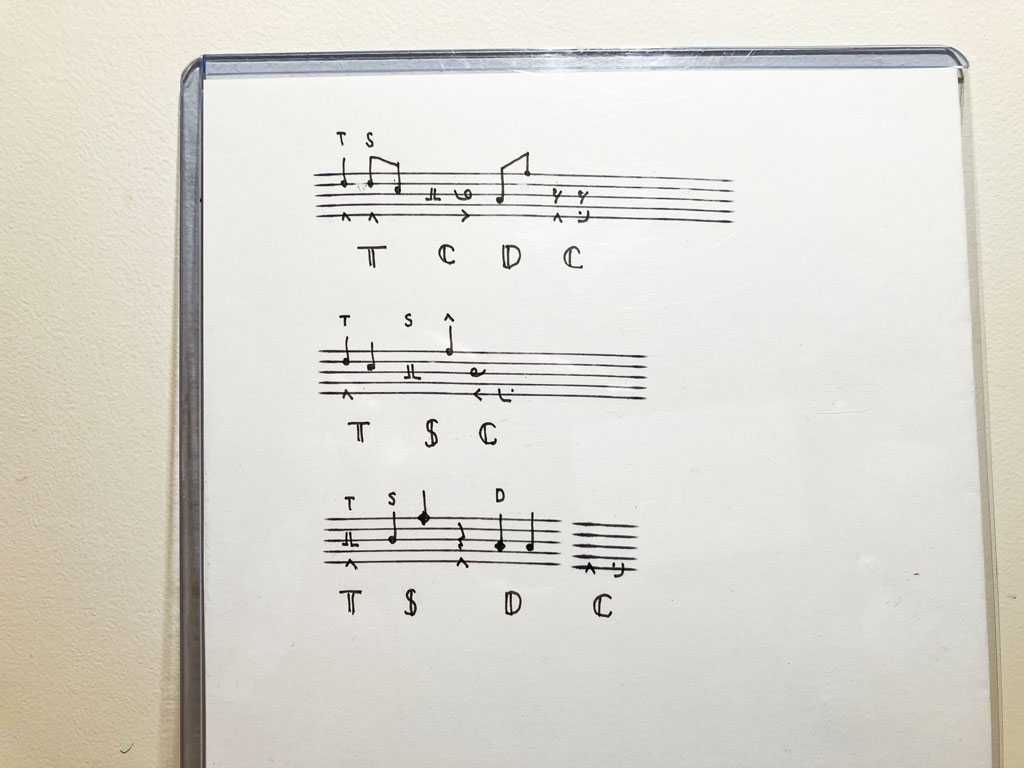
Also, by taking sheet boxing to the gym, you can check it while shadow boxing to remember which combination to practice next.
Match analysis
I think every boxer has observed professional boxing matches. However, the problem lies in defining precisely what we mean when we claim to have 'observed' matches. What I used to do when I first started boxing was to imitate movements and combinations that caught my eye during a match.
The troublesome thing here is that in intense matches, there are many combinations that you want to emulate, but you can only store two or three in your head at most, and if surpassing that number would make it challenging to absorb all of them simultaneously. When I attempted a more dedicated approach, I found myself rewatching the video until I committed it to memory. It's inefficient.
When thinking about using sheet boxing to observe matches, the first thing to consider is to transcribe it. It is a laborious task to record the movements of the entire round in a score, but by taking the time to write down how the players are moving, you can learn techniques that you might have overlooked if you were just watching the game.
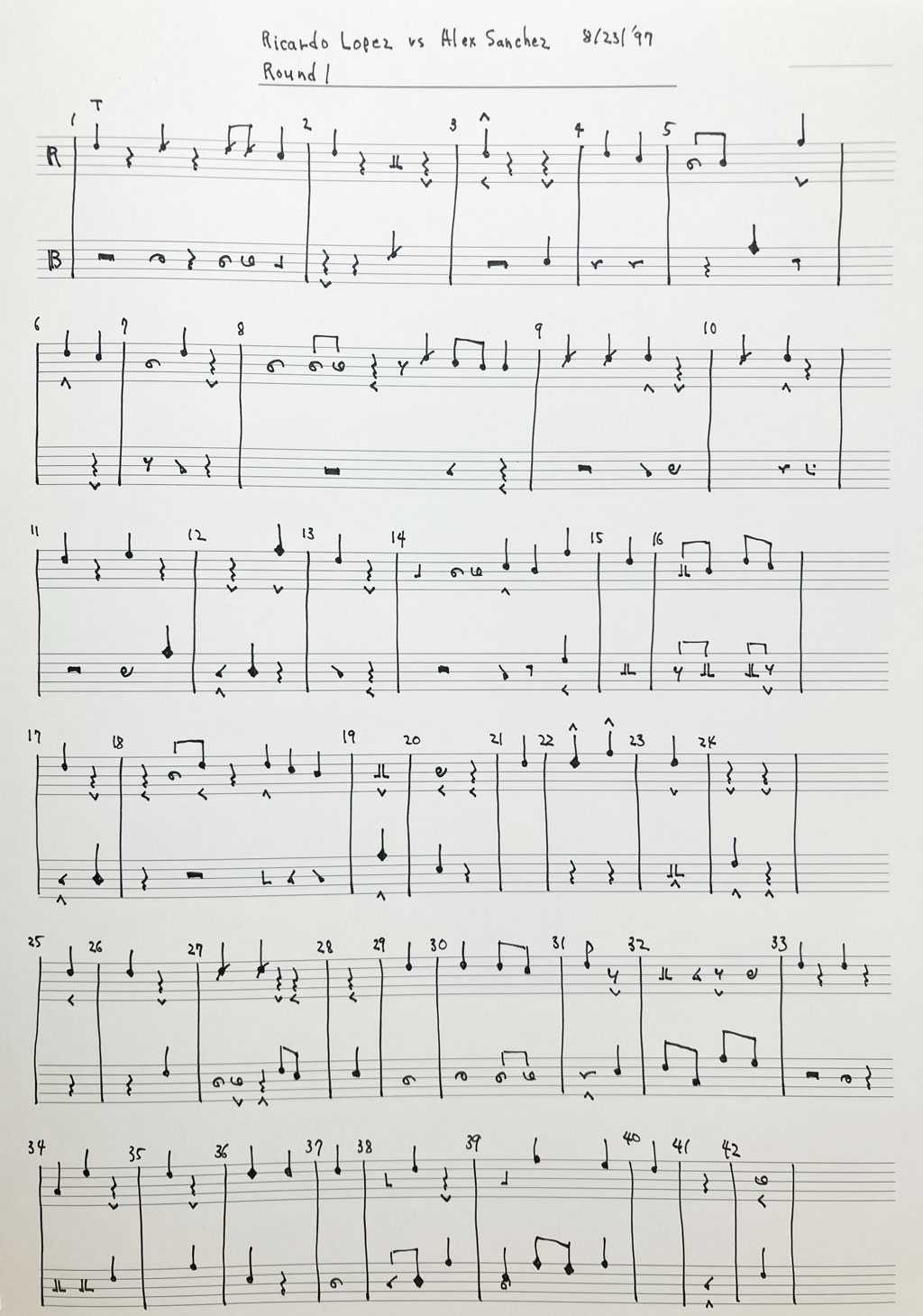
Note that music notebooks are easier to use than roller stamps when transcribing matches.
Review after practice
When you spar, you probably record it to look back on, but you might watch it only a few times after the match and be done with it.
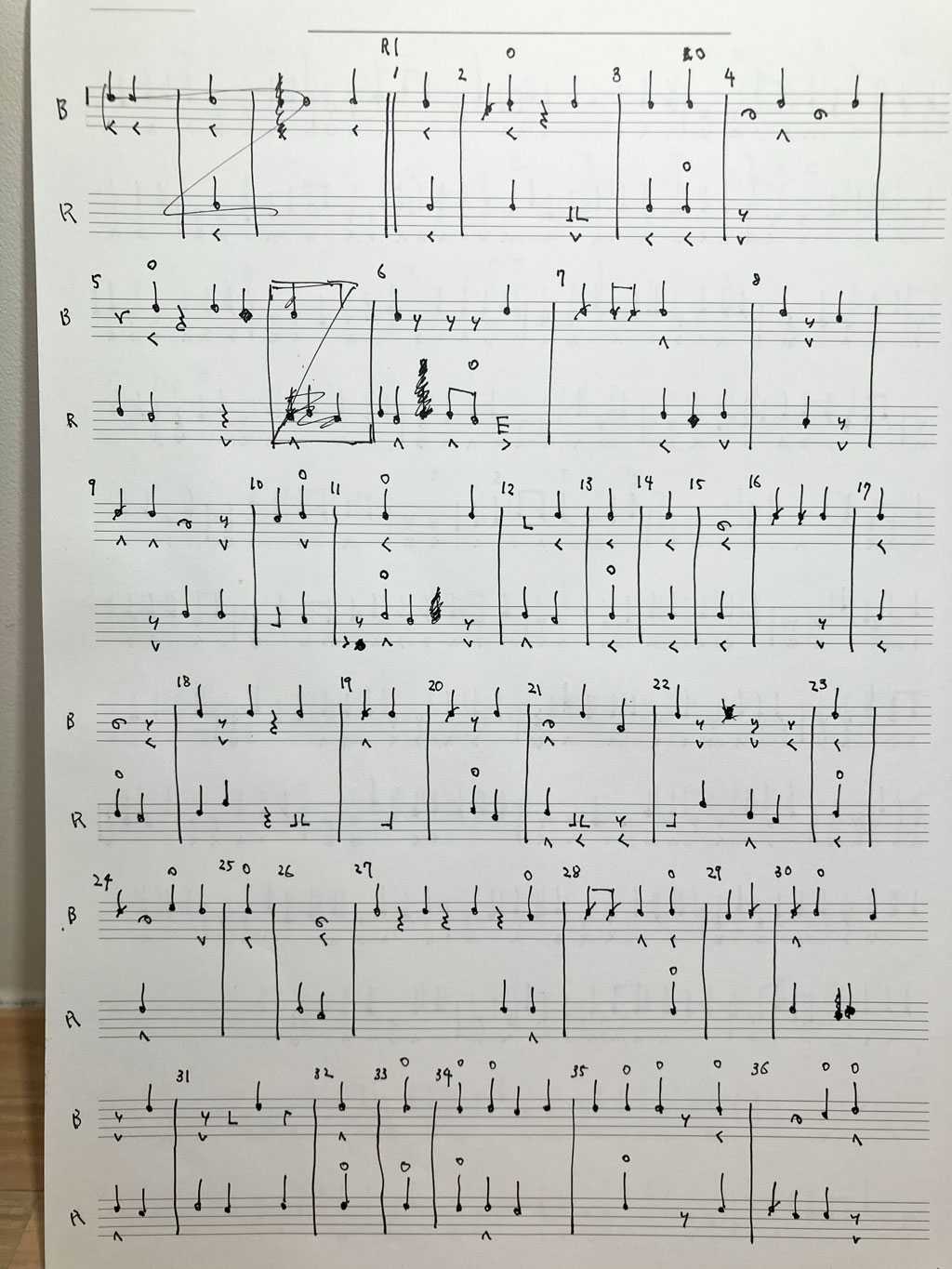
Transcription is effective not only for professional matches, but also for your own matches. It's psychologically exhausting to look back at your movements during a match where you were at a disadvantage, but you can pick up on trends that you wouldn't be able to see just by watching the footage.
By recording not only your own movements but also your opponent's movements, you will be able to understand the tactics better. As if it were a duet, you can write the movements of yourself and your opponent using two staffs.
Written boxing
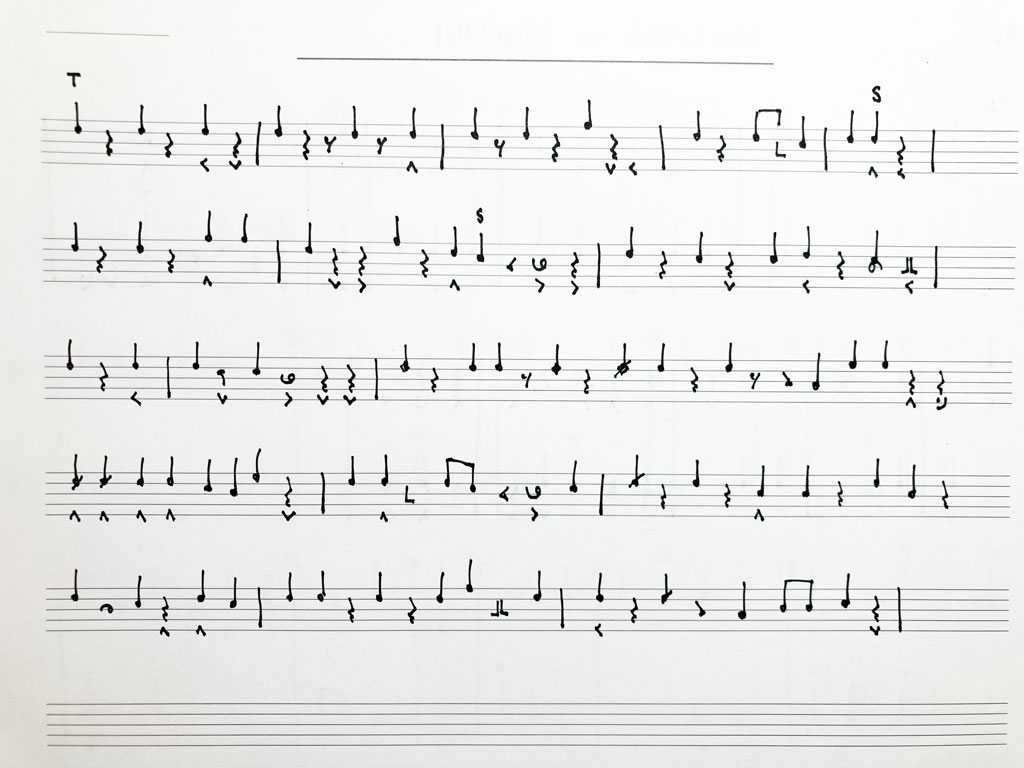
Shadow boxing is used for a variety of purposes, such as checking form and repeating combinations, but at my gym, the trainers tell me to "try to imagine your opponent's movements." These instructions assume that the purpose of shadow boxing is to simulate the movements of a match. When simulating the movements of a match, it can be broken down into two stages: (1) having an image of the appropriate movement, and (2) being able to move the body according to the image. As for stage (1), which is being able to embody the appropriate movements smoothly during a match, you should be able to do it on paper, even if you don't actually perform the movements.
At this point, opening a notebook and studying boxing becomes a feasible and effective method to deeply understand boxing. When I open my musical notebook, I write down the movements which came up in my mind as a boxing note. Let's call this "written boxing." First of all, if you can't write it down as sheet boxing, then of course you won't be able to move in a real game, so written shadow boxing can be considered a preliminary stage of practice for shadow boxing using your actual body.
Study boxing at your desk
In this way, by using sheet boxing, it becomes feasible to extract only the tactical aspects of boxing, which creates the opportunity to study boxing at a desk as a supplement to physical training at the gym. For people who are not fully satisfied with practicing at the gym or who are facing physical limitation due to an injury, I am sure this approach improves your boxing skills.