Functional Harmony in Boxing
How to deal with distance
Managing distance is a crucial aspect in martial arts, including boxing. The type of exchange, whether it's jabs or hooks and uppercuts, largely depends on the distance between you and your opponent. Therefore, considering the concept of distance is integral when strategizing your tactics.
Tonic, subdominant, dominant
In music, the sound produced by the overlapping melodies of multiple parts is called a chord. Harmony is a significant subject in music theory, with functional harmony theory classifying harmony based on its function within a musical piece.
Harmony functions are divided into three categories:
- Tonic: The most stable and fundamental.
- Subdominant: Slightly unstable.
- Dominant: The most unstable.
Typically, chord progressions start with the stable tonic, move to the slightly unstable subdominant, and then to the highly unstable dominant. Returning to the tonic provides the audience with a sense of relief. This illustrates the functional harmony theory's belief that music oscillates between stability and instability.
If music is about going back and forth between stability and instability, then boxing can be interpreted as a sport that goes back and forth between "safe" and "unsafe". In other words, you start from a far distance, observe your opponent, and then step in when you see an opportunity to move into an intermediate distance where you can be attacked with a variety of punches. If your opponent collapses, you can engage them in close combat which is challenging to both people.
In fact, there isn't any boxer who doesn't think about distance, and if you observe their vocabulary, the words about distance are categorized into three groups.
- Close distance/short range
- Intermediate distance/Middle range
- Far distance/Long range
In this way, the concept of functional harmony in music theory and the concept of distance in boxing share a common characteristic of going back and forth between three states. Therefore, I hypothesize that the symbols and classifications of functional harmony may be useful in understanding distance in boxing. In other words, the far distance in boxing can be called "tonic distance," the so-called intermediate distance can be called "subdominant distance," and the short distance can be called "dominant distance." A summary of each distance is as follows.
Tonic distance
A straight punch can cover a significant distance with a forward step, but even without it, the jab alone instills a sense of threat in the opponent.
Subdominant distance
Straight punches can be executed without stepping forward, and similarly, long hooks and uppercuts can also be delivered without the need for a forward step.
Dominant distance
Distance that short hooks and short uppercuts can be reached without the need for stepping in.
Why do we name distances?
It may seem far-fetched and pointless to borrow names from music theory, at least for something with a name like "long range." However, if we do not use words that are separate from the nature of the distance itself, such as long or short, inconveniences will arise later. For example, combinations used over long distances are later called "tonic combinations." If this were called a "long combination," it would be difficult to distinguish it from a combination with a large number of punches, which would be inconvenient.
Sheet boxing including the concept of distance
When performing a movement at tonic distance, put T at the beginning of the note, S for subdominant distance, and D for dominant distance. This clarifies the specific distance at which the movements on the sheet boxing are being performed.
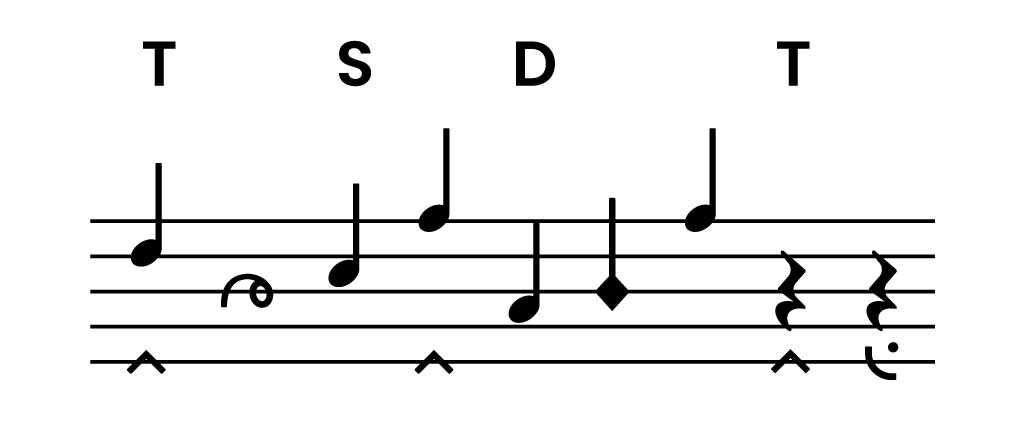
If we don't have a name for distance, we will make mistakes by not being conscious of our distance. Take weaving as an example, a defensive maneuver primarily used to evade hooks, ideally executed at subdominant or dominant distances. However, when I focus solely on practicing weaving, I often find myself doing it at a tonic distance—effectively a meaningless move from my opponent's perspective—leaving me vulnerable to attacks as I finish the weave. This was a frequent mistake I made when I first started boxing. In this way, distance symbols have an important meaning for beginners in that they are always aware of their distance when learning new movements.